The back 3, the wingbacks and where Bruno fits are the wrong questions; the real ones concern risk-reward, pressing structure and whether his model can evolve here.
29 October 2024
The real questions about Amorim are not whether a back 3 can work in the PL, nor whether we have the wingbacks for it, nor where Bruno fits into his front 3.
These questions assume Amorim would replicate his current approach - and if we assume replication, he’s doomed already.
🔴 would he be able to adapt to a world where the individual quality gap is not nearly as pronounced in the league?
🔴 would he recognize that certain aspects of his current model - such as an aggressive 3-1-6 build up - might carry more risk and bring less reward in the PL?
🔴 would he be able to rework his OOP structure (pressing, rest defense, block) to adjust the risk-reward ratio?
🔴 would he be visionary enough to build a progressive long-term model, but pragmatic enough to fix things and find solutions along the way?
If we are getting him merely for what he’s done, rather than what he might do for us, we would be replicating the flawed Glazer approach of going for a shiny new toy.
Because his previous success should serve merely as an indicator, not a copy-paste clipboard, of what Amorim or any other coach might build here. I think Amorim carries many risks and would not be my 1st pick for United.
The current gaps in his Sporting model indicate many of the same flaws that ETH had at United. At the same time, on some primal level, appointing Amorim does seem like an exciting idea.
The lesson of ETH’s tenure is that United should look beyond what the coach has achieved - and consider what he wants to do here. With the right support, guidance, honest communication & control mechanisms, I think it could work out.
Three seasons of data on shots, final-third touches, box entries and launches show United's best players being moved away from what they do best.
13 October 2024
A key aspect of our poor perfomances in the last 14 months is how ineffective some of our best players have been. Erik Ten Hag is very good at identifying individual traits and utilizing them; his lucklustre game model, however, is very poor at combining that into a coherent whole.
An element of compromise and flexibility exists in every setup, but generally speaking, you want your best players to have the highest chance of success.
That’s how to make your whole larger than the sum of all parts. And our best players are clearly not getting the best conditions to succeed. Nowhere is this more apparent than with Marcus Rashford, Bruno Fernandes and Andre Onana.
Marcus Rashford
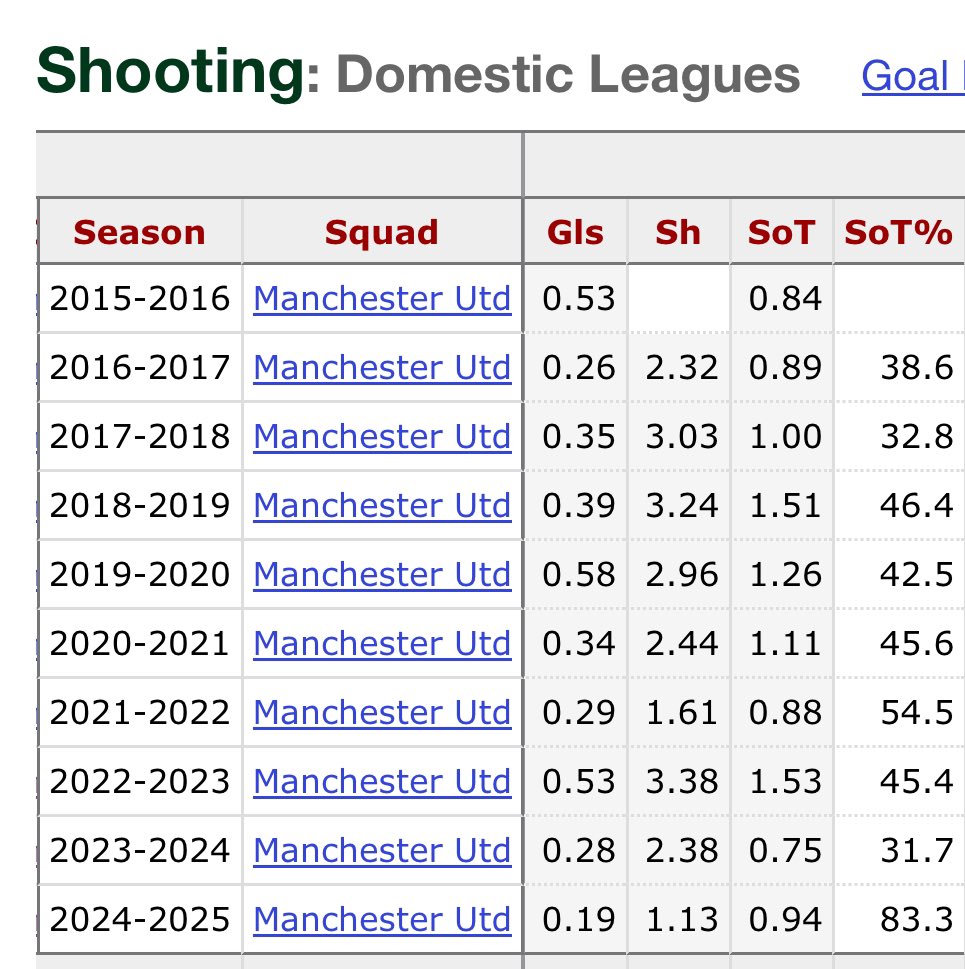
In 3 seasons under ETH, Rashford has consistently been having fewer and fewer shots:
2022 / 2023 - 3.38 shots per 90 2023 / 2024 - 2.28 shots per 90 2024 / 1025 - 1.13 shots per 90
A dramatic 66% drop ⚠️
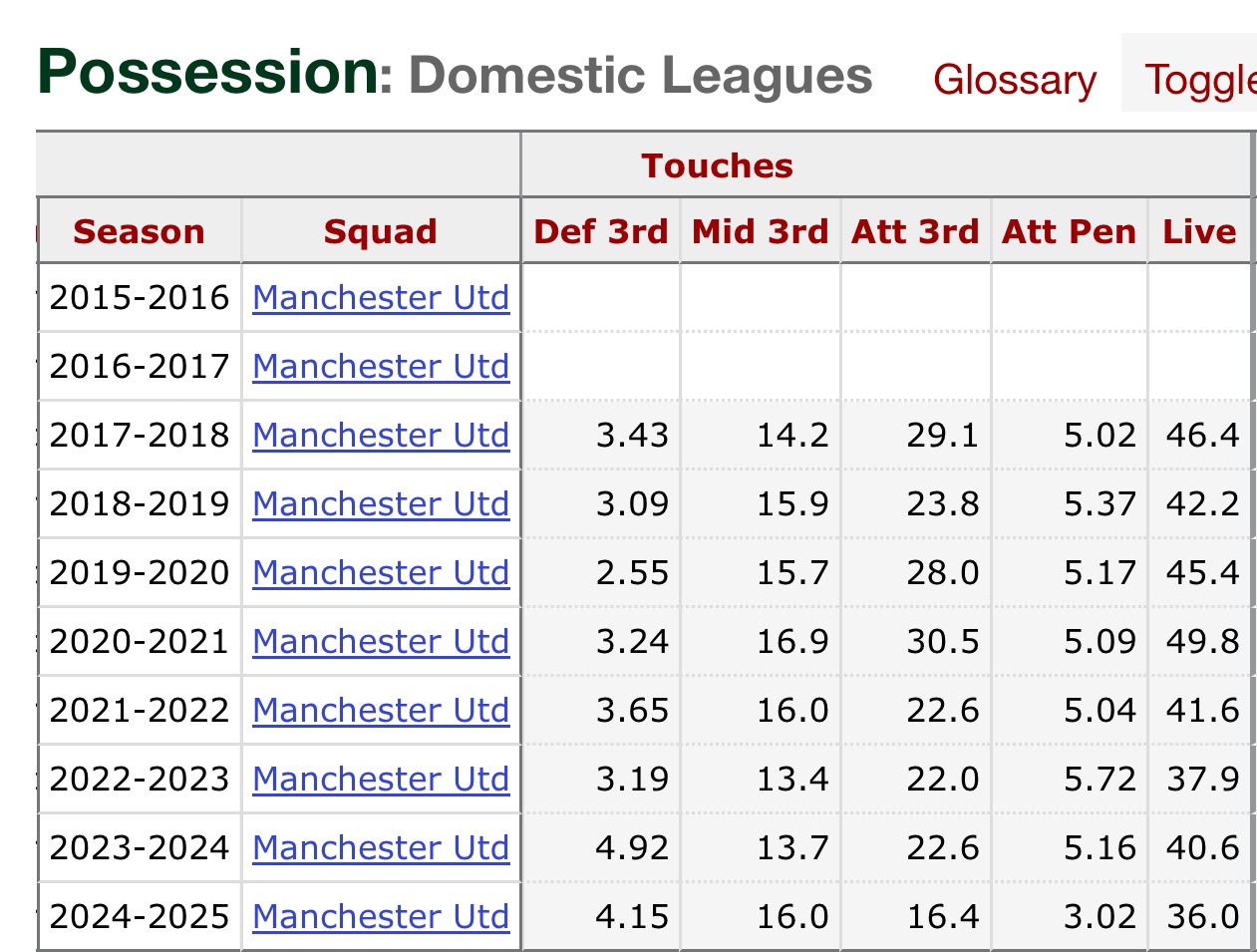
Is it because he’s gotten more insecure and thus reluctant to shoot? Maybe, but it’s primarily about where Rashford plays and what his tactical function is. Consider the percentage of his touches in the final 3rd:
As you can see above, it’s even worse for his touches inside the pentalty box. It went down from 5.72 per 90 in ETH’s 1st season to 3.02 this season - almost a 50% drop ⚠️
And Marcus has been receiving fewer progressive passes, too: 7.66 in 2022/2023 down to 6.60 now. His defensive & build up duties went up considerably. Rashford now has 30% more touches in own our 3rd, compared to ETH’s 1st season.
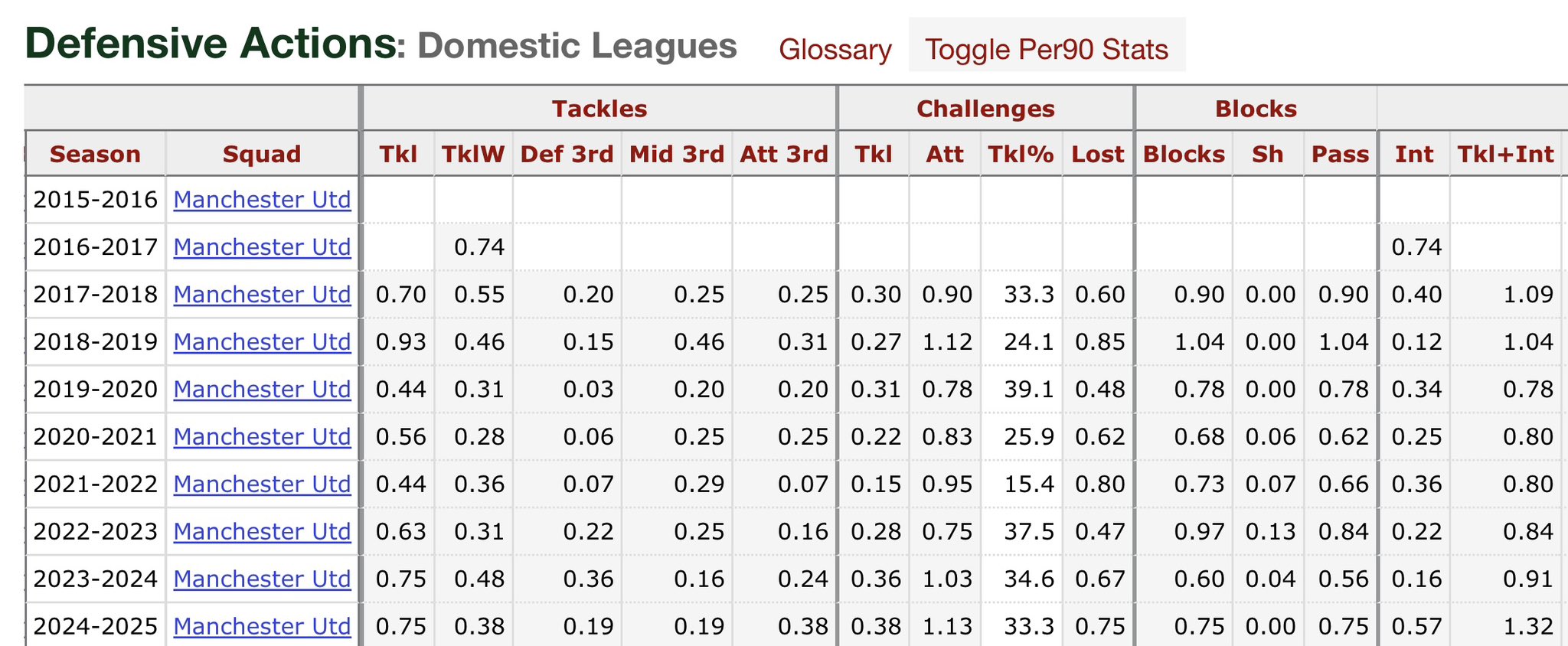
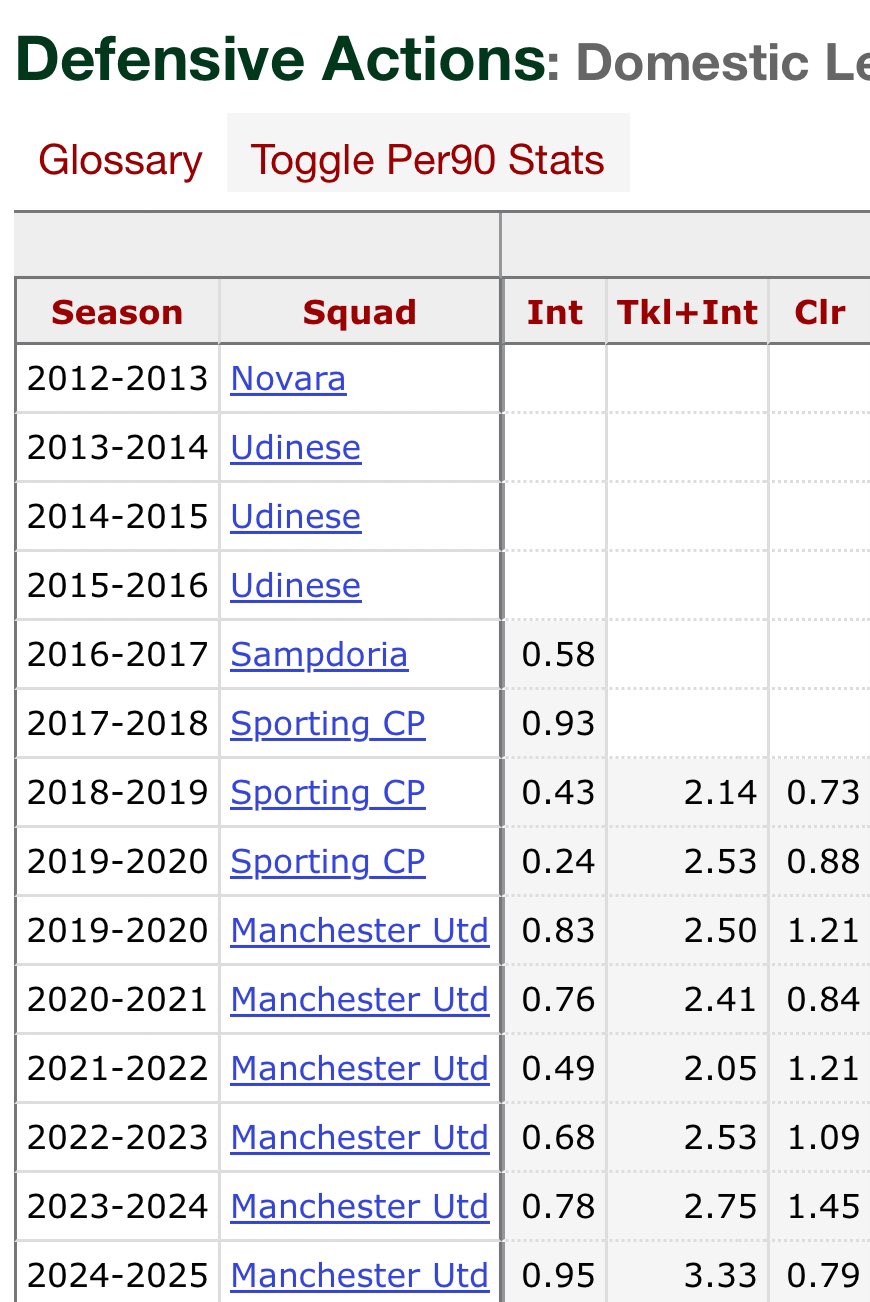
Tackles & interceptions per 90 have gone up, as well:
In short, it’s clear ETH initially used him as an attacking outlet for our transitions, but has now switched to a more traditional winger role & duties.
The system no longer prioritizes getting Rashford into the box from wide positions. Rather, he’s often too deep and too wide.
Since Rashford is not elite at things such as small spaces playmaking, but is absolutely elite at entering the box & shooting from wide positions, it becomes obvious why this setup is not getting the most out of him.
Next up, our main man Bruno.
Bruno Fernandes
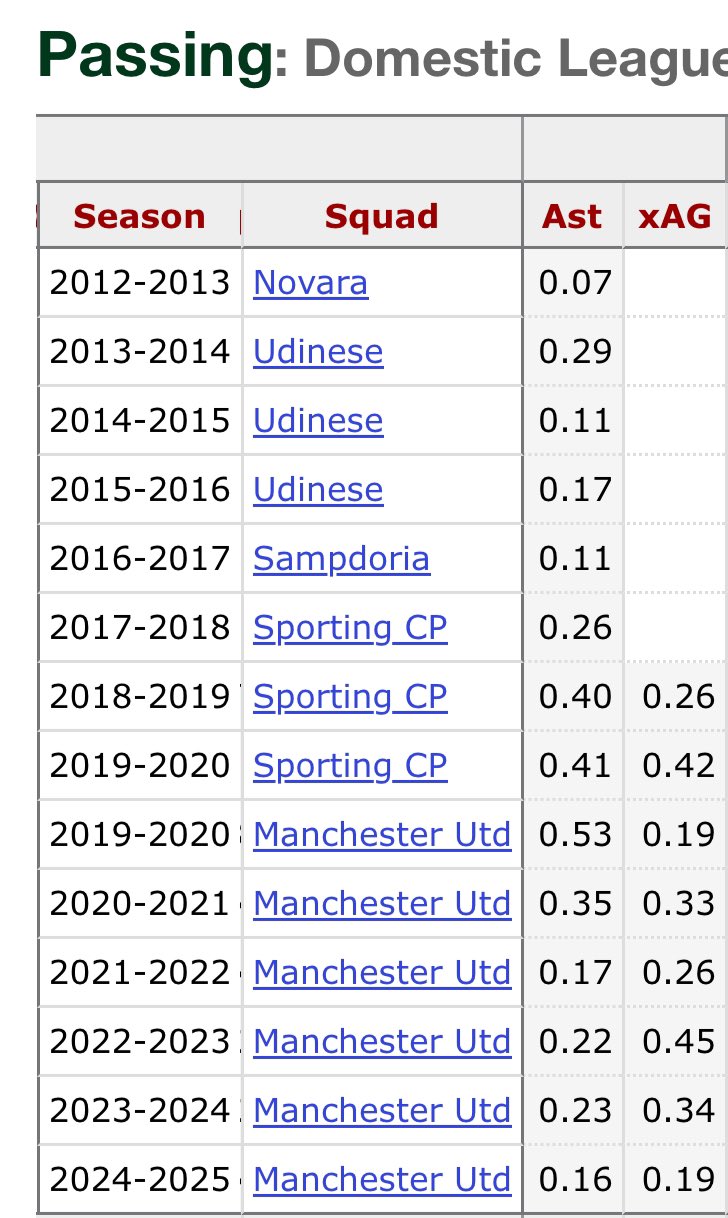
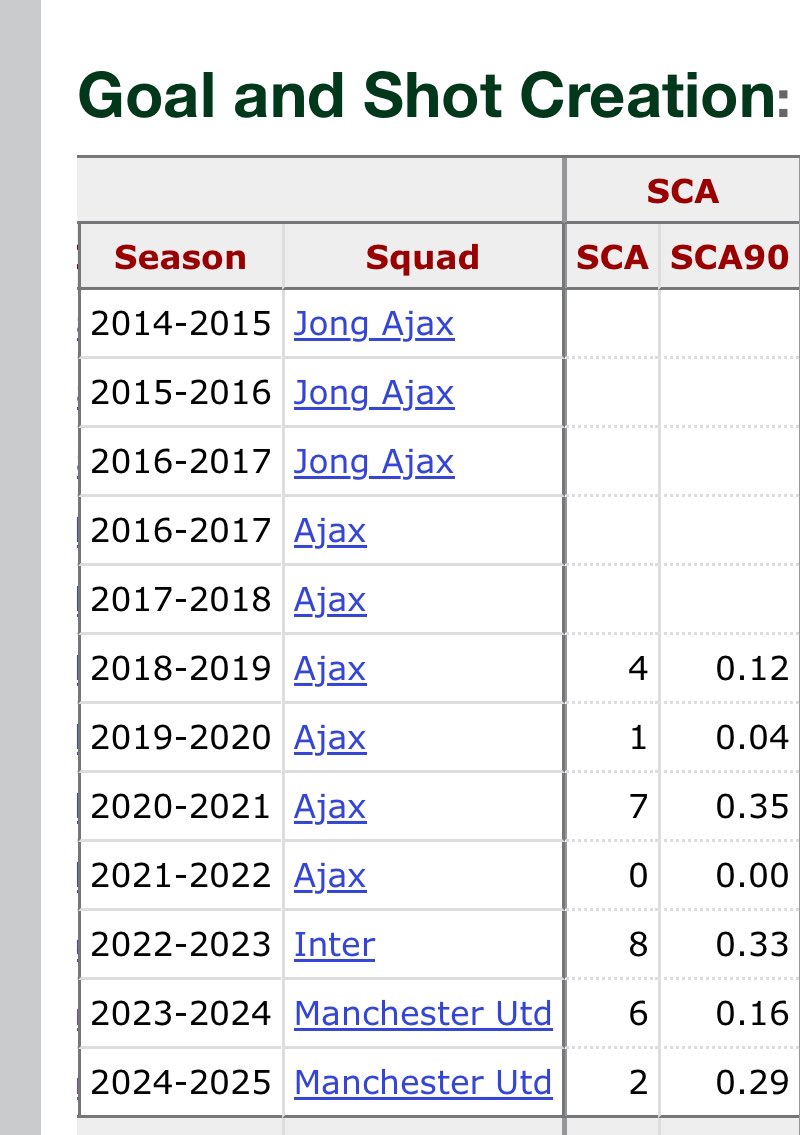
In 3 years under ETH, Bruno has consistently been creating fewer and fewer expected goals from assists:
2022 / 2023 - 0.45 per 90 mins 2023 / 2024 - 0.34 per 90 mins 2024 / 2025 - 0.19 per 90 mins
A 58% drop in xAG ⚠️
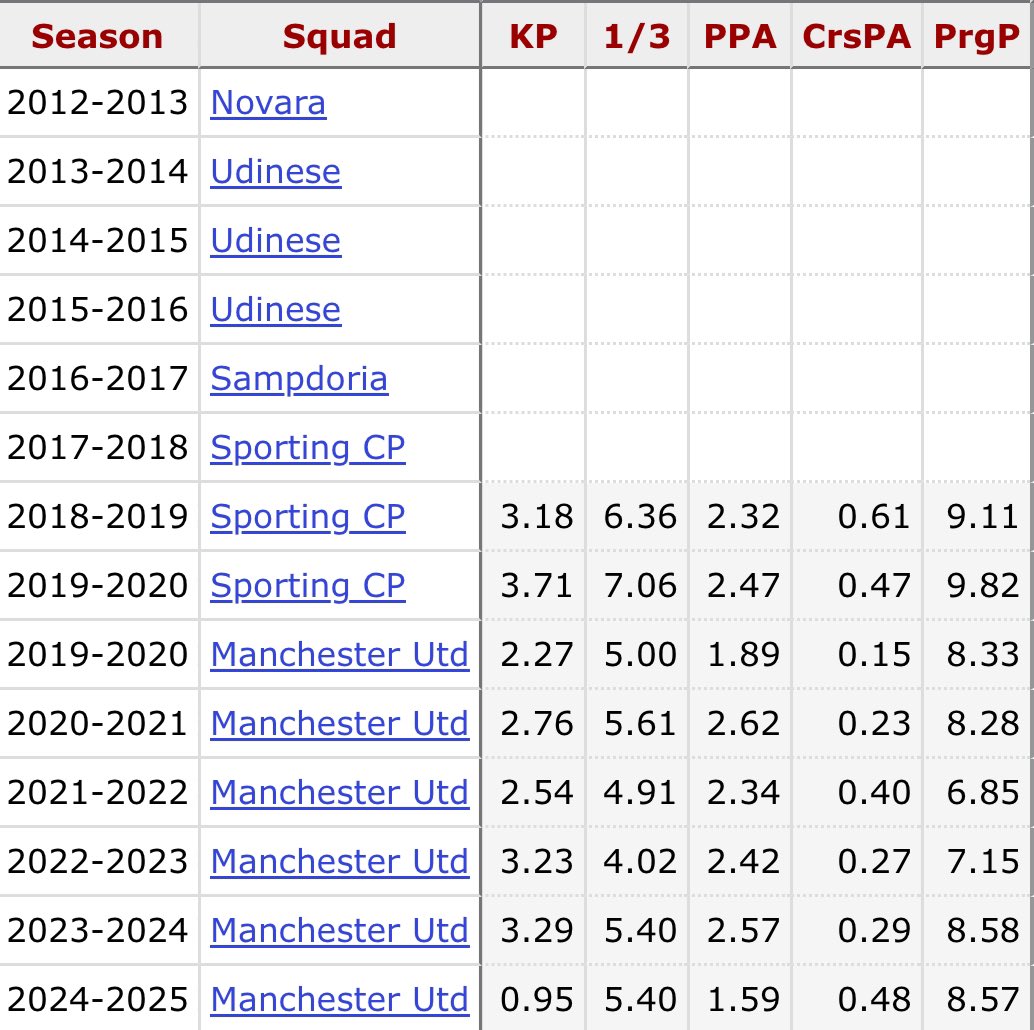
His numbers are also down for passes into pentaly box, from 2.42 in ETH’s 1st season to 1.59 this season.
And key passes are down, too, from 3.23 to 0.95 per 90 mins this season.
Is it because Bruno has less creative or less secure? No - it primarily has to do with where he plays.
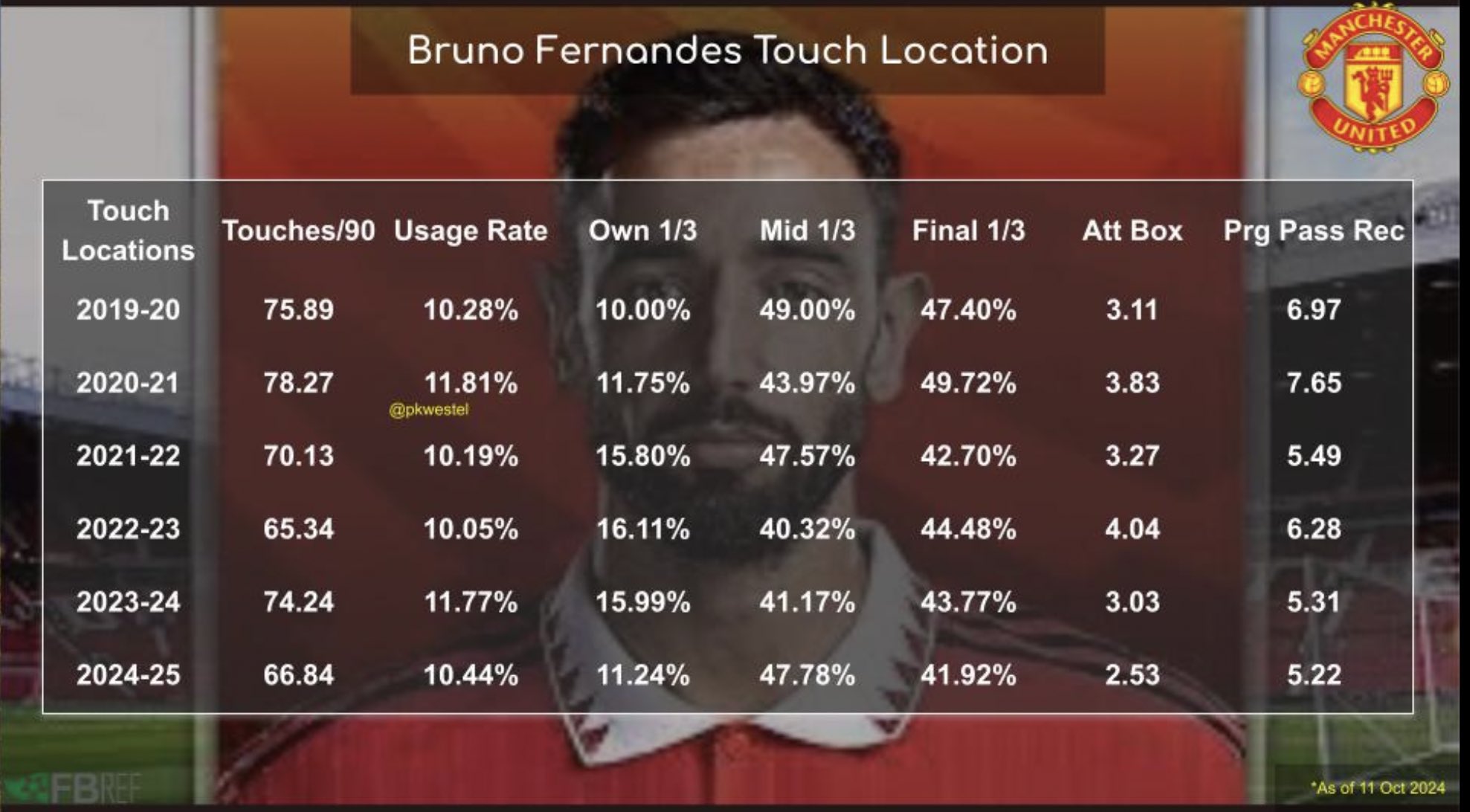
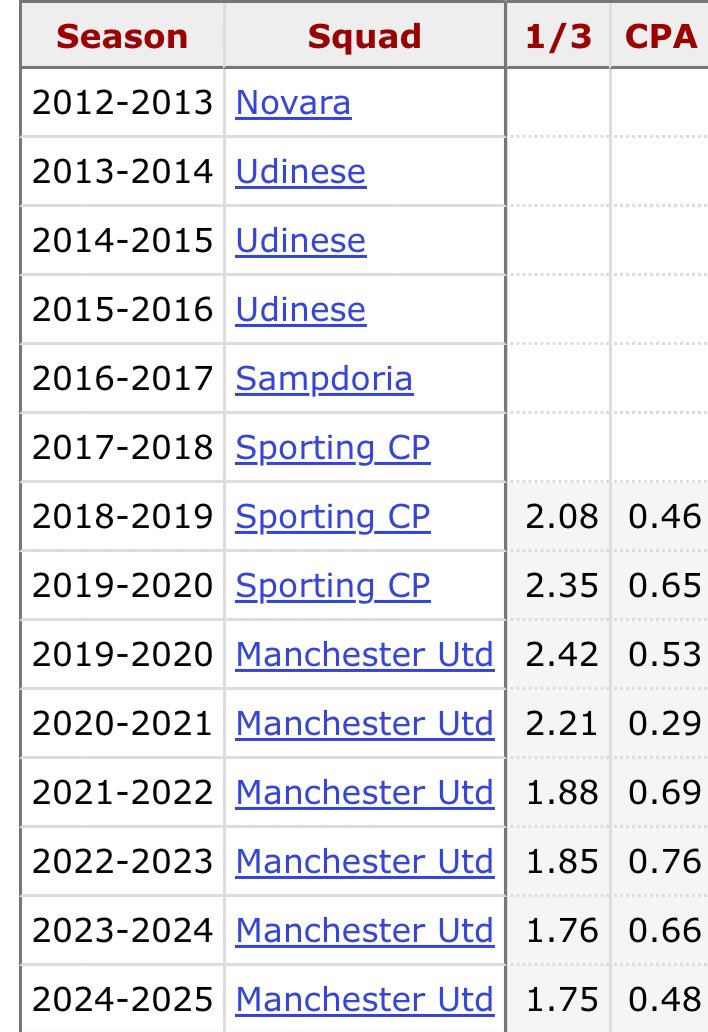
Consider the percentage of his touches in the final 3rd:
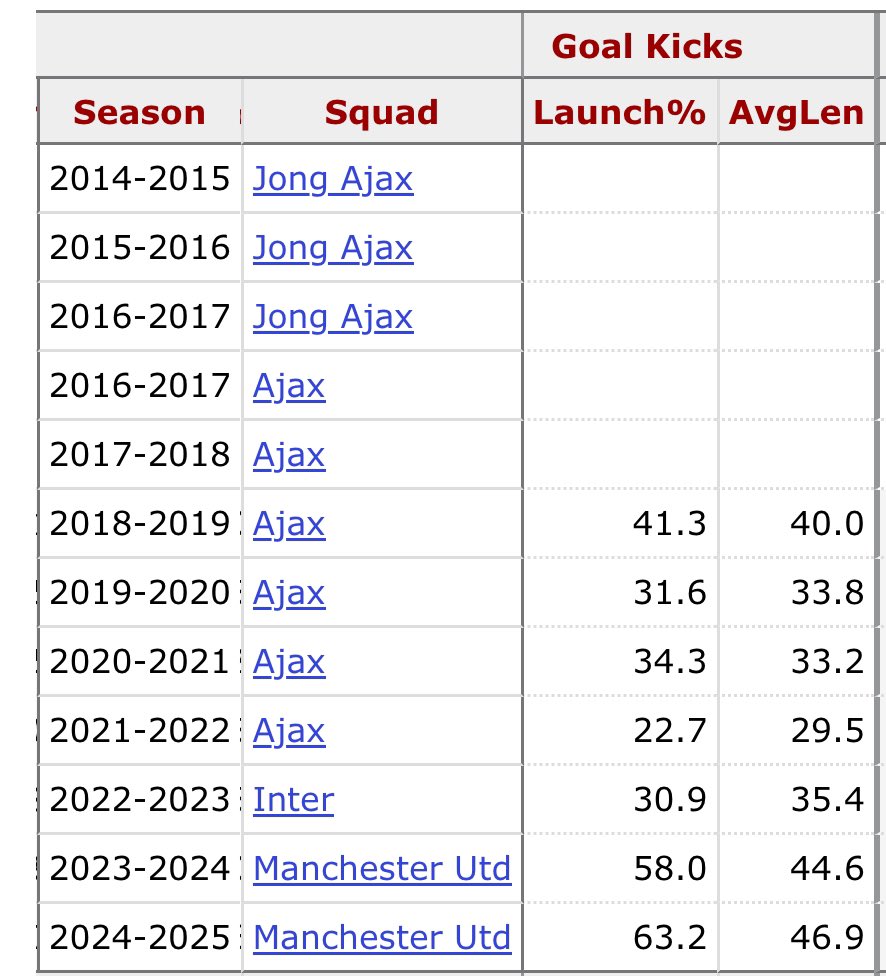
An incredible 104.5% increase in launches since his Inter days ⚠️
What is really interesting is that these long passes resulted in *fewer* chances leading to shots.
Like the rest of our back line, Onana has been going direct way too soon, before opposition blocks have been manipulated.
A 50% drop last season ⚠️
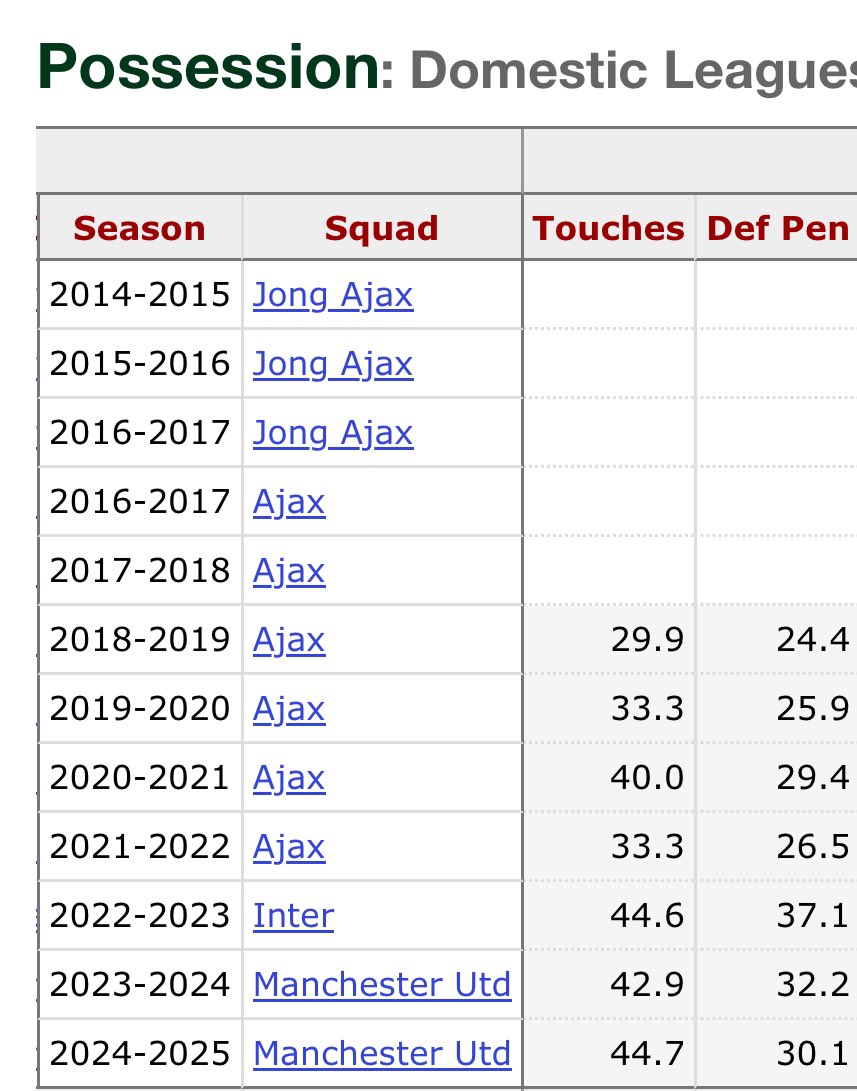
In addition to this, we’re clearly reluctant to use riskier deep baiting with Onana involved during build up.
Thus, the percentage of his touches inside our box has been going down:
Though a less radical example of misuse than Rashford and Bruno, it seems obvious we’re not utilizing Onana’s skills as well as they were utilized at Inter.
And the dramatic increase in launches indicates it’s about tactical intent, not his personal downfall of some kind. The weird thing here is that Onana has previously played under ETH. He was brought in to raise our technical ceiling in build up. He now plays behind an Ajax-dominated defense. And yet we are using him to launch it long.
What this adds up to
These 3 players are key for our building, creating & scoring - and they’re not being used to the best of their abilities. Through different tweaks & decisions, ETH has made them less efficient & productive. And they are far from only examples of suboptimal use.
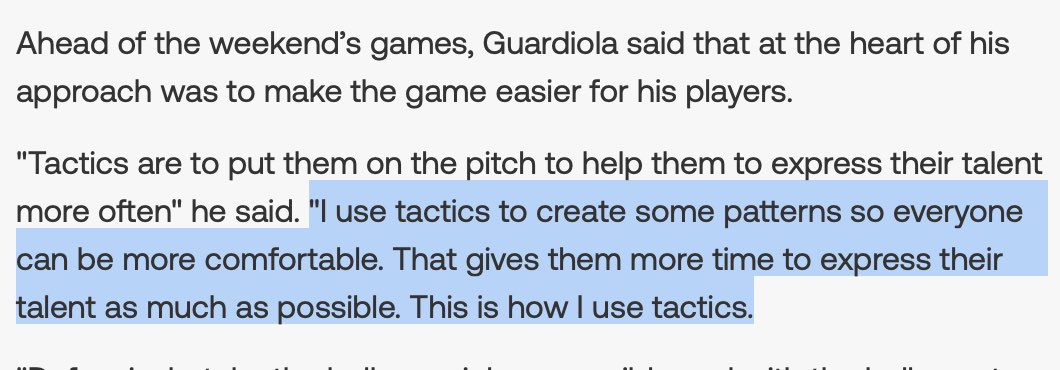
Guardiola once said his job is to create tactical conditions & patterns that allow his players to execute well. Using Pep’s adage as a metric, we’re clearly failing to do so - and the result has been bottom-half form.
Have our key players been perfect? No. But they are not bottom-half players. Is our squad perfect? No. But it’s not a bottom-half squad.
(Credit: @alraven3)
Think about this before you call the players lazy, unstable and unworthy. Think about this before you believe the rage-baiting pundits.
Think about this before you launch into simplistic angry rants against them. Context matters. Context always matters.
The compact block, primitive baiting and vertical attacking that worked in 2022/23 became the end product rather than the pathway, and United never moved past it.
7 October 2024
In 2022 / 2023, his first season at United, Erik Ten Hag created a pragmatic tactical model that maximized individual quality and got great results, until it started collapsing. And 2 years later, United are still haunted by it.
The model relied on a compact mid / low block off the ball and quick vertical movement on the ball, an effective cocktail of box defending and fast attacking of the opposition's box. There were important differences between that and what Ole did in previous seasons.
While Ole was looking to win the ball in the midfield, compressing it with a high defensive line, ETH was content to soak up more pressure and rely on reactive box defending. Why? Because the model actually invited teams to press us, so that we could play through them. We wanted Licha and Shaw to have time on the ball, baiting opponents into high pressing.
It was, in fact, the model's key feature: when teams took the bait, we'd quickly get the ball to Eriksen or Casemiro, who would then spray risky progressive passes up front to Rashford or Bruno. It was simple, but very effective, maximizing quality in the team:
Why the idea has to precede the personnel, and what Ten Hag's refusal to commit to one approach costs United in recruitment, coaching time and identity.
2 October 2024
In 1997, as the infamous story goes, Steve Jobs went back to Apple.
The place was in shambles: financially ruined, with a terrible corporate culture, bad products, misguided strategy, no clear vision and pack of elite talent in key areas.
At one point in 1997, Apple was 90 days from going bankrupt.
The crux of the problem was that the company was clinging to sweet yet toxic memories of its glory days - while also forgetting what had brought them glory.
If it sounds familiar, that’s because it is familiar; at one point or another, it’s a destiny of many a great organizations and individuals.
Jobs had a clear insight on what was fundamentally wrong, and out of that, his plan was hatched. You can call it his philosophy, vision, strategy or, in football terms, tactics. But the comeback started with a clear idea on what to do.
Apple, he sensed, was trying to do to much - personal assistant gadgets, printers, a different zillion computer models - while doing none of it at a very high level.
It was trying to pretend it hadn’t lost the computer war to Microsoft and that it was still a big company, the default choice for most consumers. Which then led to countless terrible product decisions.
Klopp's exit closes the era of gegenpressing as a system in itself, and United under Ten Hag have once again arrived at the tail end of a tactical cycle.
14 May 2024
Last night against Villa, Liverpool were once again unable to hold on and control the game, conceding two late goals to squander the lead. This inability has cost them a trophy-filled final season under Klopp; more broadly, it has cost them many trophies during the Klopp era.
And as Klopp leaves the stage, so does gegenpressing.
Gegenpressing elements have become so integrated in almost every tactical model today, that gegenpressing itself is no longer a viable standalone system.
Paradoxically, thus, the more popular gegenpressing became, the less viable it became. And I would argue it has reached its natural evolutionary end.
What Klopp brought
When he arrived on the scene, Klopp represented a breath of fresh tactical air, masterful in articulating and executing on his "heavy-metal football" vision. Was he the first to employ gegenpressing? Of course not, not even the first in the Bundesliga.
But Klopp was the most radical and prominent gegenpressing evangelist, basing his entire gameplay on this notion of winning the ball as soon as possible and attacking unsettled defenses.
Because that's what it was, at its core: an attempt to distrupt teams before they had a chance to build their attack, and then to attack them before they had a chance to organize their defense.
It was the perfect, extreme antidote to Pep's patient possession model which ruled Spanish, European and international football for years.
Where Pep sought control with the ball until he manipulated space to attack, Klopp's model embraced chaos and speed. It exploited possession systems at their most vulnerable at the time - 1st stage build up and rest defense.
High block pressing was not prominent at the time, and in turn, 1st stage build up wasn't nearly as elaborate as today. It was an innocent time before progression patterns, press baiting and other mechanisms.
And similarly, rest defense, even in top teams, was not nearly as good as it is today. They just didn't get hit by opposition as much after losing the ball, thus they did not care for it as much.
The two models copied each other
What followed for the past decade was a fascinating interplay of two approaches, especially after Klopp and Pep both joined the PL. It was tactical evolution at its finest.
Slowly, two styles also started copying from each other to stay ahead. Guardiola added elements of directness while Klopp was trying to add elements of control.
His last Liverpool teams, while still direct, were not nearly as vertical as his first. And yet, Klopp couldn't find ways to fully tame the beast he was nurturing.
Season after season, Liverpool were able to break defenses through speed & verticality, but they were also getting often exposed at the back, unable to see games through. And now we're seeing the same thing at Manchester United under Erik Ten Hag.
With a system that's much less systematic than Klopp's, relying on individual traits rather than structure, it's been a complete disaster. Add a few important injuries to that, and the whole thing imploded quickly.
But I would argue it's not just a problem of execution; in 2024, gegenpressing is a problem of vision, too. Opponents have adapted, coming up with ways to bypass Liverpool's menacing front press & to break their rest defense.
Even relatively average teams are trying to use press baiting, for example, or formation variations to play through presses, dropping DMs into backline, inverting or pushing FBs forward.
Even average teams now have ball-playing keepers, making it harder for heavy-metal pressers to regain the ball.
A tactic, not a game model
Gegenpressing as a tactic, a part of the system, is still very potent. Almost every top team uses it today, in some way or another, trying to compress the field and win the ball back as soon as possible.
But gegenpressing as a standalone game model, it turns out, is now a fairly low ceiling model. When done correctly, it can be devastating and exciting; most of the time, though, it's not sustainable at the top level.
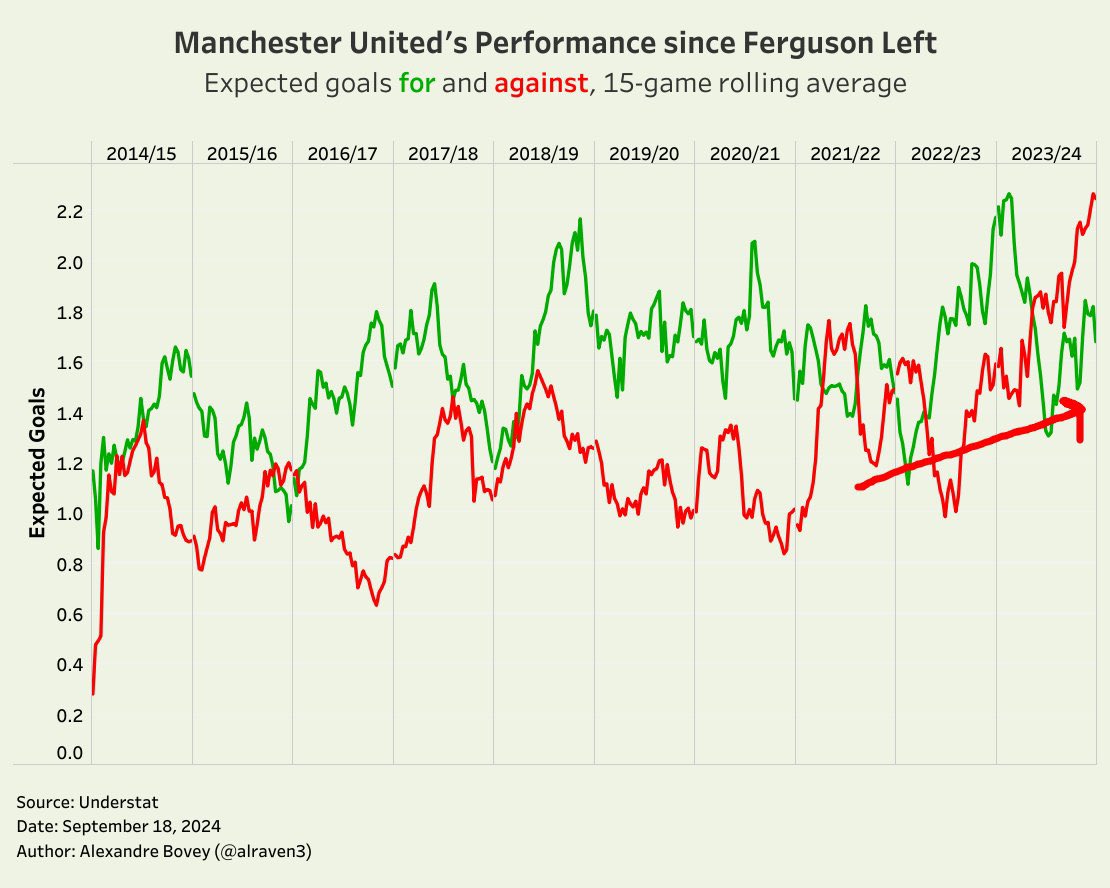
Three causes: a club that never replaced Ferguson's structure, a manager whose principles stopped adapting, and a media war neither side could win.
18 December 2018
There are, I think, three key causes of United's decline under José Mourinho (and that it is indeed a decline is shown by a whole series of rather unbelievable statistics: 36 shots on goal, which is what the Red Devils allowed Liverpool; 29 goals conceded in the league, which puts them among the worst English clubs; a record-poor points haul, the like of which hasn't been seen since 1990).
The club that never replaced its paradigm
The first, structural cause, which we wrote about a year ago, concerns the club itself. Alex Ferguson's departure represented an organisational, ideological, operational and value-based shock for which United didn't know how, or more precisely couldn't, prepare. By all accounts coming out of United, the gap behind their rivals is deep and dramatic, from scouting and player selection systems to a neglected academy and the absence of any long-term sporting strategy.
In five and a half years the club will have changed five managers; a sign that we can't lay all the blame at the feet of a now humiliated and beaten Mourinho. The post-Ferguson transfer policy that puts global megastars front and centre — club directors openly boasted that they found inspiration for their development policy in Real Madrid, without noticing that Real itself had abandoned the Real policy. Careless, unwise and clumsy statements like "We can buy anyone in the world", repeated whenever United sit low in the table, make United's directors look like caricatures, puffed up and clueless about their own job.
Thirty-five years after Ferguson arrived at Old Trafford, United are still structured around a man who wove himself into every pore of the club.
21 July 2017
Manchester United play the big city derby against City tomorrow, and the date of the match is one of the most important in the club's entire history; a date the fans recall from year to year with ever greater nostalgic regret. On that 6 November, now 35 years ago, Alex Ferguson arrived at Old Trafford as manager, a 45-year-old Scot who would later become a 'sir'.
We have written about United in the context of Ferguson's legacy on several occasions, and probably the most complete text is this one from way back in 2017, which in some of its details is, in some strange way, still very much relevant today. So we are recalling it in today's Weekend rear-view mirror.
In the summer of 2013 Alex Ferguson left the Manchester United bench; the experienced Ferguson did not plan to go without securing a good starting position for his successor. In the articles that in later years revealed the details of Ferguson's preparations for retirement, one could make out a plan by which United's bosses intended to ease the beginning of the new era.
For months he negotiated with Cristiano Ronaldo's representatives about a triumphant return to Old Trafford, which was supposed to happen in the transfer window ahead of the start of the 2013/2014 season – it went so far that they were arranging when and how the official stadium announcer at Old Trafford would read out Ronaldo's name during the match between United and Real Madrid, with the idea that a strong ovation from the home fans might encourage Ronaldo to come back.