The Carrick approach
Carrick’s in-possession ideology is detailed in the first two phases and deliberately loose in the final third; the worry is out of possession.
As often is the case, recent United debates are difficult to wage because they seem to conflate basic terms and ideas: ideology with solutions; principles with mechanisms; strategy with tactics.
My take: Carrick has a clear in-posession ideology, principles of play, for all 3 phases. That ideology is supplemented by a host of specific solutions for the first 2 phases, but gets much less defined once the team progresses the ball into the final third.
In the final third, it’s much more about general roles and specific players used in those roles. This, I think, is by design, not a lack thereof.
The idea seems dynamism and Carrick’s version of fluidity, i.e. to give the players a general attacking paradigm, a broad framework, without stiffling their creativity and unpredictability. It’s not the caricature of “let the boys cook, come what may”, but it’s not positionally rigid nor based on automatisms, either.
What follows is that a lot of United’s final 3rd play ends up being defined by player traits and natural inclinations, more than anything else. To a lesser extent, this is visible in other phases as well; in the final 3rd, though, it seems to be the core intent.
This final 3rd approach represents a throwback to a previous era, but in this new transitional context of the PL, with few teams sitting deep and just waiting it out, it might not be as rudimentary nor crazy as it seems.
When it clicks, it looks fluid and unstopabble, but when it doesn’t, it can be chaotic and impotent, players getting in the way of other players, lack of width and depth, lack of bodies up front etc.
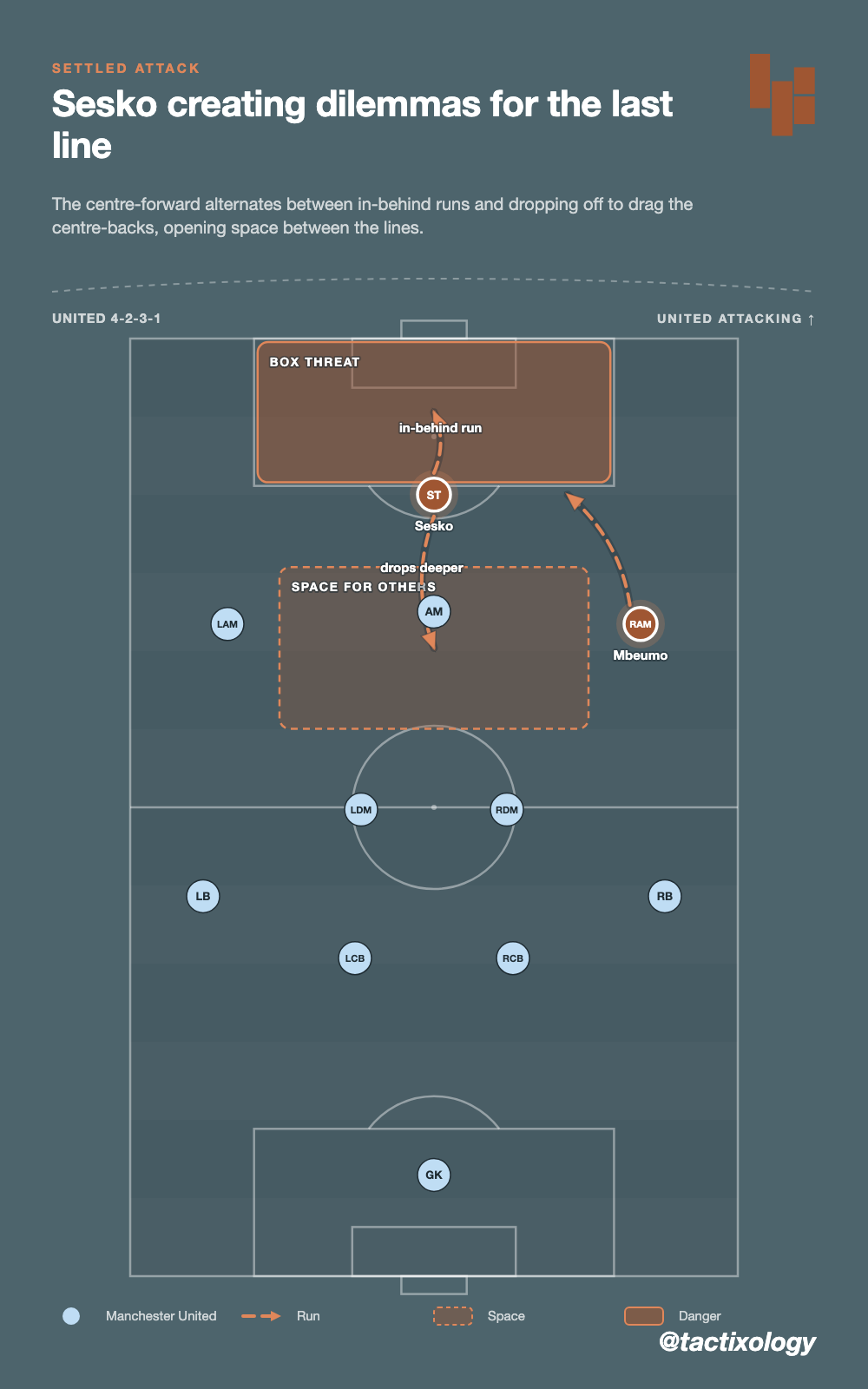
Sesko is a good example: he is a true CF, meaning that he applies pressure to the last line, stretches and occupies the CBs, looks for in-behind runs, provides a serious box threat, but also drops deeper from time to time, to drag the CBs and create more space for others. In other words, he creates dilemmas for the back lines, as does Mbeumo.
When Cunha operates up front, it often results in him being too deep too often, which means opposition defenders have much less to worry about. He’s not a credible aerial threat, and his natural instict is to run towards the ball and carry it, not to look for pockets of space to run into. The advantage is that he can drop deep and form a playmaking quartet of Mainoo, Tielemans, Bruno and himself, but the cons of that outweight the pros.
I think Carrick will get the in-possession balance right, most of the time, especially once Amad gets back. Will that be enough for a top 4 finish? I’m uncertain - as the team develops, I do think more structure will be needed.
It’s the out of possession stuff that I’m more worried about. The general principle of combining zonal & m2m pressing is correct, but the execution has been subpar, to say the least.
Again, the basic ideology is there, but the specific solutions are neither abundant nor excellent. And without the ball, you really need specific solutions and structure; allowing player instincts to take over out of possession is a recipe for disaster.