How Amorim adapted
Three pragmatic changes — direct progression from the goalkeeper, Amad restored at right wing-back, and a more compact out-of-possession shape.
After the Brentford defeat, Amorim managed to implement a number of pragmatic tweaks to his system; and to his credit, they seem to be working well
What changed, specifically?
1. New progression method
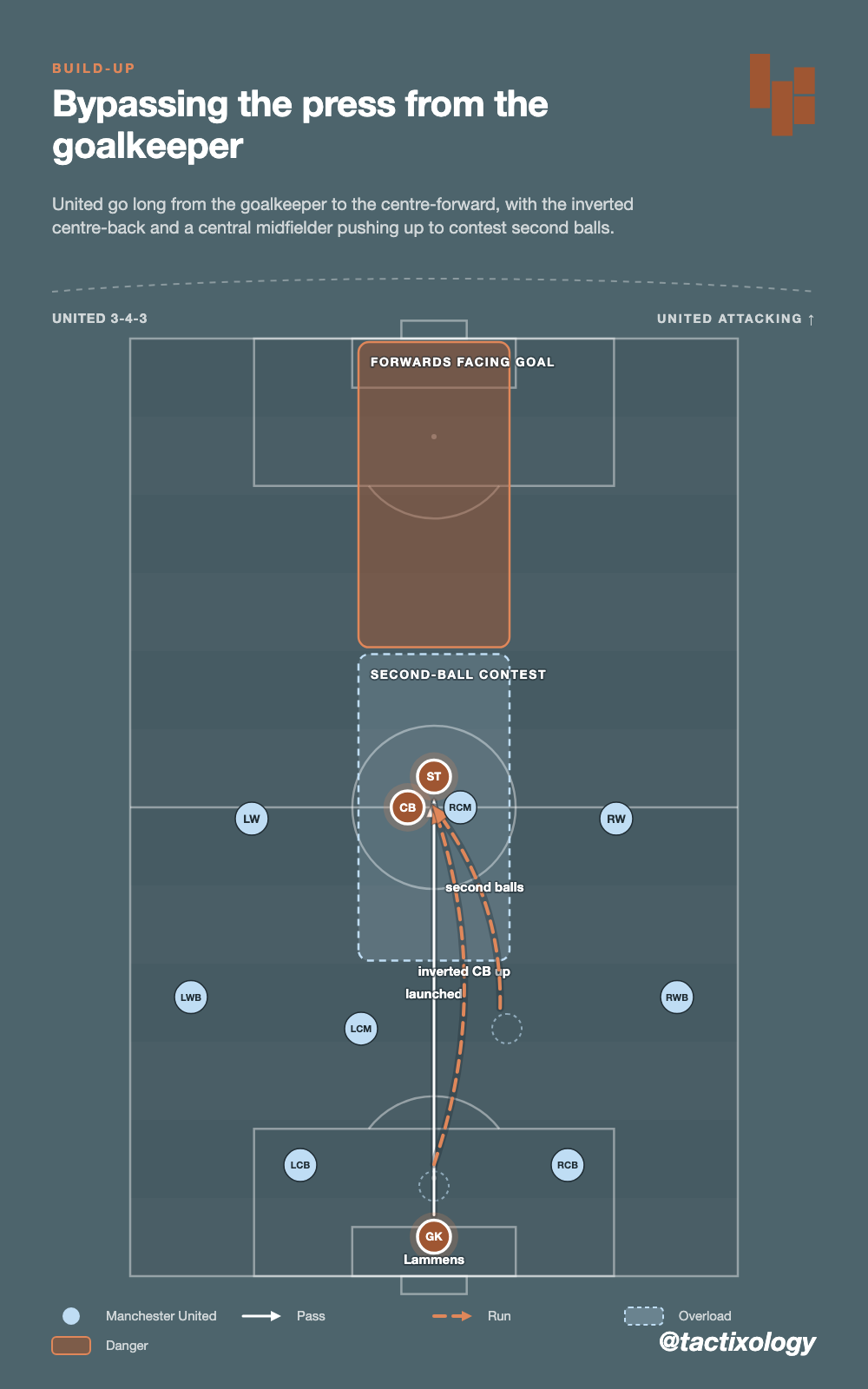
By introducing Lammens into the team, we also introduced going long from GK to forwards much more often.
Percentage of goal kicks launched:
- 33% vs Brentford
- 87.5% in post-Brentford games
- 75% vs Brighton
Same thing for open-play passes by GK, in terms of short vs long: 41.7% launched vs Brentford, then 75% in the 3 games after that.
What is even more interesting is that we are involving the GK more than before, to launch those long passes.
Passes attempted by GK:
- 24 vs Brentford
- 36 in post-Brentford games (avg.)
- 41 vs Brighton
Of course, as dicussed previously, relatively few of these end up as successful long passes, claimed by the player they were meant for.
But that’s not the point: the point is for the team to be positioned well as the pass is made, to duel for 2nd balls and counterpress if ball is lost.
What has this change led to?
Basically, bypassing the first and second phases of possession - and the opposition’s press - to quickly transfer play up front.
From Amorim’s view, this has 2 advantages: a) limiting the dangers faced vs m2m pressing and b) getting our most dangerous players close to the goal and facing the goal.
Percentage of touches in final 3rd:
- 15% vs Brentford
- 24% in post-Brentford games
- 28.8% vs Brighton
This massive increase of 89% between Brentford and Brighton means that United are spending much more time where they should be - in front of the goal.
This direct threat should ease the willigness of opposition teams to press us high, in a m2m system, because they will fear getting caught in the back.
Amorim must use this fact to re- introduce short build up and press baiting: a combo of these two basic strategies could prove unstopabble.
But if we end up over-exploiting one method, teams will find a way to stop us.
Side note: funnily enough, inverting the CCB works much better with this long, direct strategy rather than short build up.
The CCB moves up, which means one of the CM can move up, too, to better challenge for second balls.
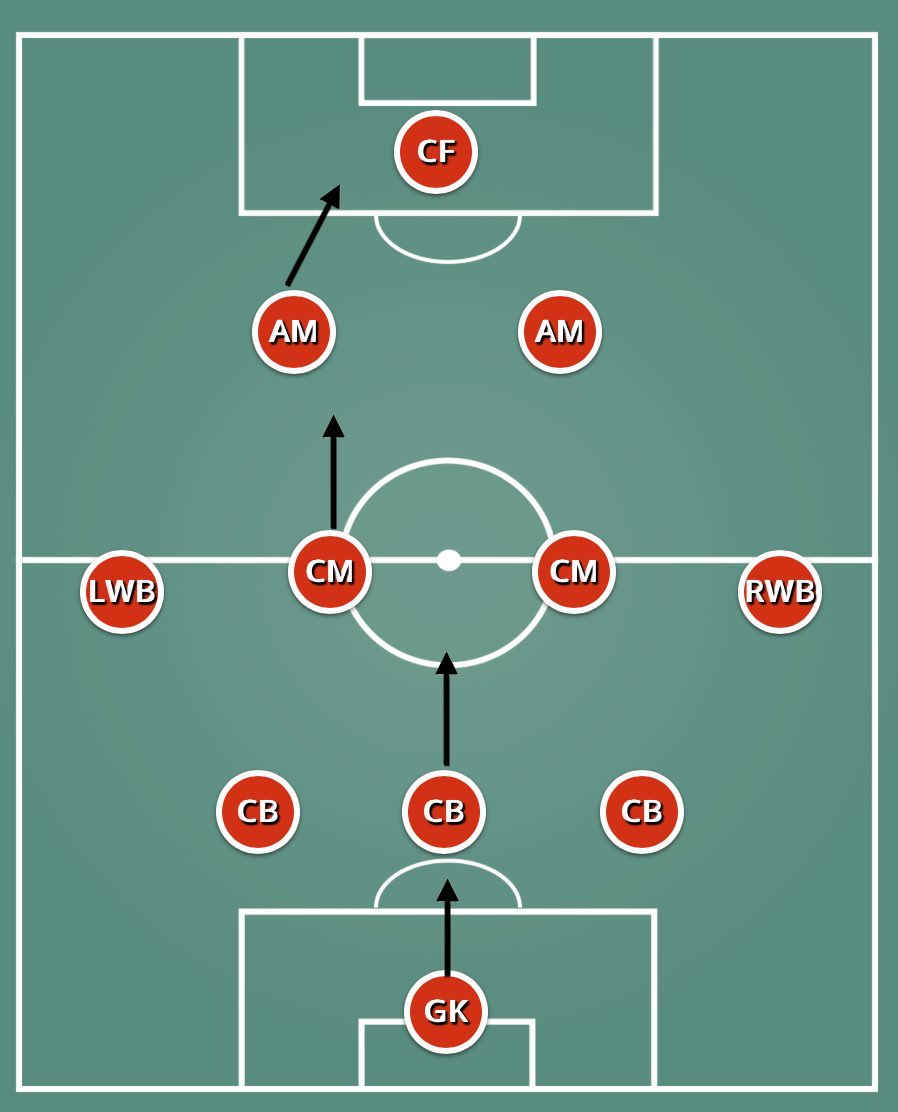
2. Return of Amad as RWB
A change that seems to have gone slightly under the radar is the return of Amad as our primary RWB option.
Started as one of the AMs against Grimsby, Chelsea and City + missing the Brentford game had a massive, underappreciated negative impact.
Simply said, Amad is the only true WB option we have on that side. Without him, we remain too flat and passive,
This was the case last season as well: when a FB was played there, our progressive carrying & final 3rd play suffered greatly.
Progressive carries per game:
- Amad: 5.45
- Mazraoui: 1.55
Successful take-ons per game:
- Amad: 2.08
- Mazraoui: 0.79
And most importantly for our new progression method, Amad ventures into forward areas much more and is able to receive there.
Prog. passes received per game:
- Amad: 8.88
- Mazraoui: 2.34
Amad has been back as the starting WB in the past 3 games, and it shows - especially as the connection with Mbeumo improves.
In a 3-4-3, the 10s will always be a challenge for the opponents. But much more so if they are flanked by proactive, progressive WBs.
3. OOP & 5-2-3 improvements
This one is of pivotal importance, but still imperfect.
First of all, we stopped pressing high with only three forwards, leaving major gaps between our front and midfield units.
Now it’s usually either 5-4-1 or 4-4-2 (at times against Brighton, even seemed like 4-1-4-1 or a 4-2-4 block). And was often man to man.
Crucially, the back line is much more active, timing their jumps well to support the midfield.
The result of these two changes - one of structure, the other of coaching - is that we have become more compact in central areas.
There’s still space to exploit and more works is needed, but it looks significantly improved and much more aggressive. See Zohair’s excellent thread below:
The changes Amorim introduced are not groundbreaking; they are common sense changes. Which is precisely what makes them good.
Platforming your best players well and keeping things efficient & simple worked great for ETH in his 1st season, for example.
I see a lot of posts implying that Amorim didn’t need to change a thing in order to win. That it was all about player quality, mentality, etc.
This is only true if you think the formation = the system. He kept the basic formation, sure, but changed a lot of systematic things.
For example, in posession, United have gone from lots of retention in 1st phase & attempts to progress through wide overloads, to going direct from CBs to AMs, to going long and direct from the GK to the CF.
That’s a lot of tweaks since last season.
The very fact Amorim adapted - and adapted with success - gives hope for the future more than any single change introduced.
Now, can we keep this going? I’m more optimistic after Brighton than I was after Sunderland and Liverpool.
It was a more complete and mature performance, not as hectic and random as Anfield seemed at times.
A good warning to heed would be ETH’s aforementioned 1st season.
He made pragmatic tweaks and got excellent results. But as opposition adapted, we lost momentum and fell apart completely in 2nd season.
The step up to a more progressive system never happened.
Amorin deserves serious credit for introducing major changes to his system, boosting the physical levels of the squad and keep it together during a terrible run of results.
But he would be wise to think ahead and not let opponents catch up too soon.