Carrick's basic positional attack has made United static
A fundamentally different in-possession ideology has produced familiar output: plenty of entries into the box, few quality chances, and nowhere to run.
On a macro level, the transition from ETH’s and Amorim’s to Carrick’s in-possession models and intent has been substantial.
Both ETH and Amorim relied on numerous variants of direct attacks to quickly progress the ball & attack space behind the last line.
In ETH’s case, mostly counters (season 1) and counterpressing (later seasons). In Amorim’s case, long balls, usually from CB or GK to CF, and winning 2nd balls.
These approaches resulted in quick progression, lots of low-quality shots and some high-octane sequences, but sacrificed control, specifically territory, possession & rest defense structure, since we were losing the ball when distances between players were huge.
What Carrick has been trying to do is achieve more control through high possession and to attack the last line more often, instead of constantly trying to find space behind it.
The paradox is that his fundamentally different approach has thus far yielded similar results. We’re once again seeing a high level of output in terms of getting to the box, with few quality chances.
Why this might be? A part of the answer is that the final 3rd still lacks clear structure and is mostly based on individual roles rather than shared team intentions. And those roles have been less than ideal.
For example, the CF is being used as a part of the 2-2 central box, which helps with progression but has had a negative effect on the whole front line, lacking presence up front.
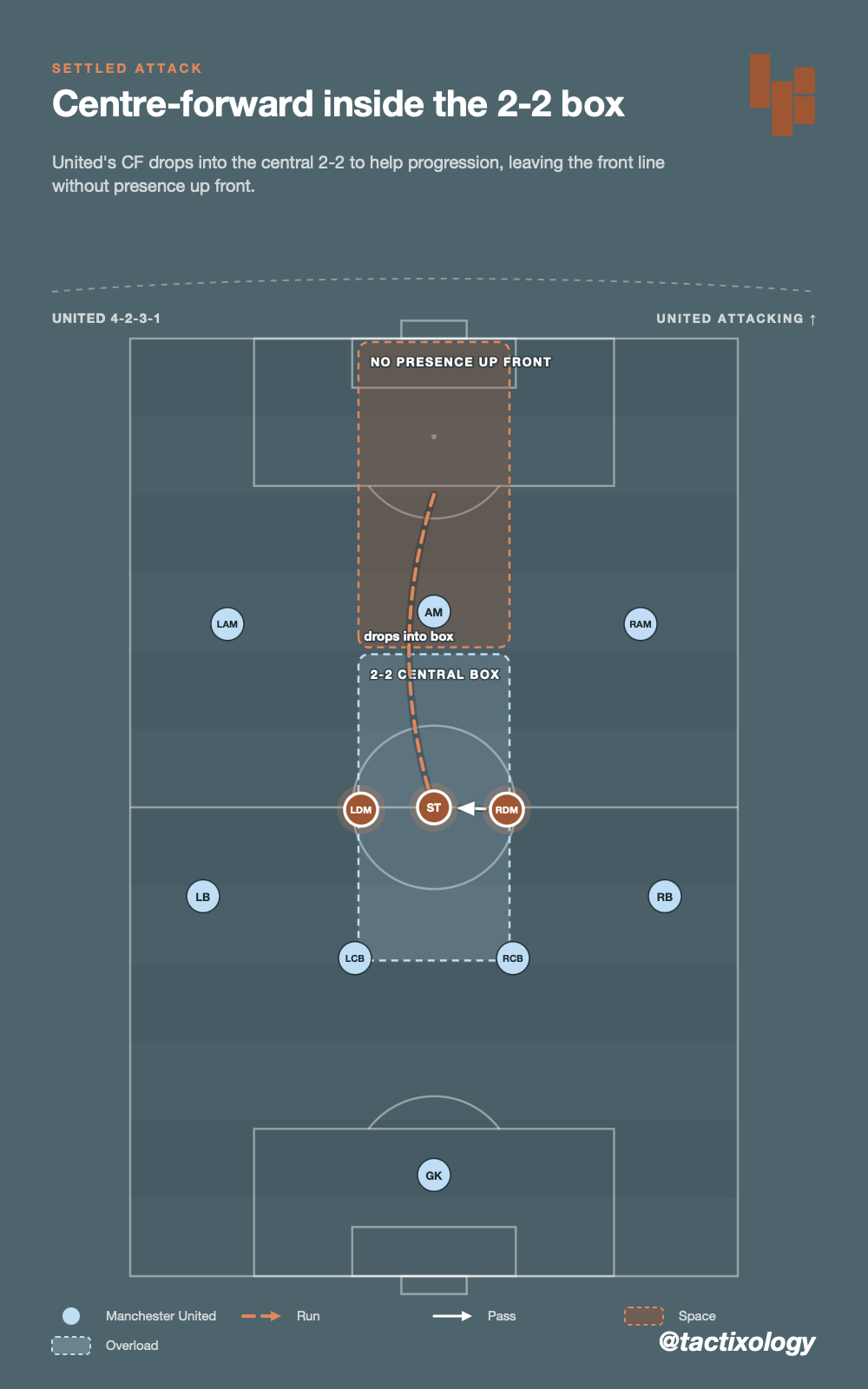
In addition to this issue, I believe we’re also seeing an attempt by Carrick to introduce more rigid structure into the final 3rd, which is now creating a host of new problems.
After the season opener, the shock defeat against Hull in which we forced things way too often & early, it seems a more positional approach was taken.
The idea seems to be to avoid loss of control and regression to the more frantic direct attacks of the recent past, which comes naturally to some of our players.
But this attempt at positional play has been very basic, severly undercoached, lacks correct profiles and goes against the current tactical meta of the PL.
The result has been a very static attack in recent games, except when opposition are way below our level.
This is one of the big reasons those running stats are misleading!
They don’t show a team unwilling or physically unable to run. They’re showing a team that can’t run because it has nowhere to run to.
It’s not like these players suddenly can’t or won’t sprint. It’s that space is not being created for them to sprint into.
Varun also higlights this same attacking issue that we’ve had for years, under different coaches.
This has probably been where we sit in this graph for years. High shots but low quality. Indictment of poor coaching for attacking sequences. All our coaches just give in to high freedom to be unpredictable & end up having lots of unstructured player-driven trigger-happy play. https://t.co/QCs4fQ9mqP
— @TheDevilsDNA 21 Sept
A tendency to give in to notions of freedom, chaos and “United DNA”. It sounds good and romantic in theory, but usually fails to work out.